
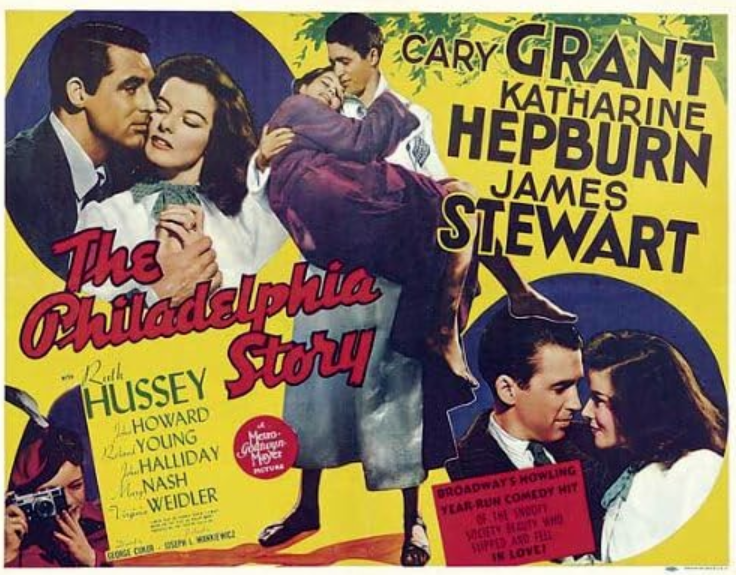
C.K. Dexter Haven. That’s Cary Grant’s name in The Philadelphia Story. Archibald Leach was his name when he was a boy in Bristol and not yet an actor in Hollywood.
C.K. Dexter Haven was a little confusing to me the first time I came across him. I’m not sure I had ever seen any of those screwball Cary Grant films – or any other “old movies” at all, for that matter – before my dad took us to see The Philadelphia Story in downtown Portland in the late 70s. It might have been shown as a first run movie in that place more than 30 years before we saw it. When it came out, my dad was only four years old. And yet there we were, when almost nobody even watched TV on a black-and-white “TV set” anymore and certainly no new movies in theaters were in black-and-white, piling into the Chrysler and going downtown on a Saturday afternoon to do this thing. My little brothers and I were (as always) perfectly happy to go along with whatever our zany dad had in mind, but going to a movie theater to watch an old movie seemed a bit daft, even for him.
I have a vague memory of the theater’s being somewhere near where the Schnitz is now, but I can’t be sure about that. Memory is slippery. I have a much clearer memory of my mom’s mood. She was wearing her “okay, but be careful” face at the beginning of that day. It was the face she wore whenever she got caught between being the submissive wife and being a participant in my dad’s optimistic sense of adventure.
The ride to the theater was fine. She wasn’t mad. Yet.
Do you know the movie? It’s a masterpiece. It’s proof that even in the late 1930s popular culture knew the difference between being good and being polite, and that manners are not the same thing as morality. It’s also a story about the humanity of us all, regardless of our material situation, and – this is the part that sent my poor mom over the edge, I think – a lot of the the lines are delivered by characters who’ve had too much to drink.
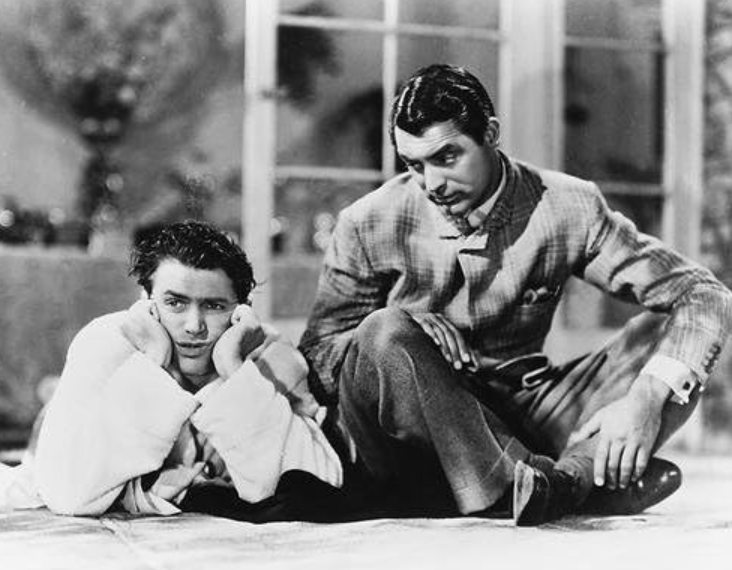
In one scene of sober individuals, when the wealthy leading lady has just accepted a wedding present from the equally wealthy C.K. Dexter Haven (her first husband) and has become engaged to George Kittredge (a once poor, now increasingly admired up-and-comer everyone in the film thinks is a bit of a putz), their conversation goes like this:
- George Kittredge: You’re like some marvelous, distant, well, queen, I guess. You’re so cool and fine and always so much your own. There’s a kind of beautiful purity about you, Tracy, like, like a statue.
- Tracy Lord: George…
- George Kittredge: Oh, it’s grand, Tracy. It’s what everybody feels about you. It’s what I first worshipped you for from afar.
- Tracy Lord: I don’t want to be worshipped. I want to be loved.
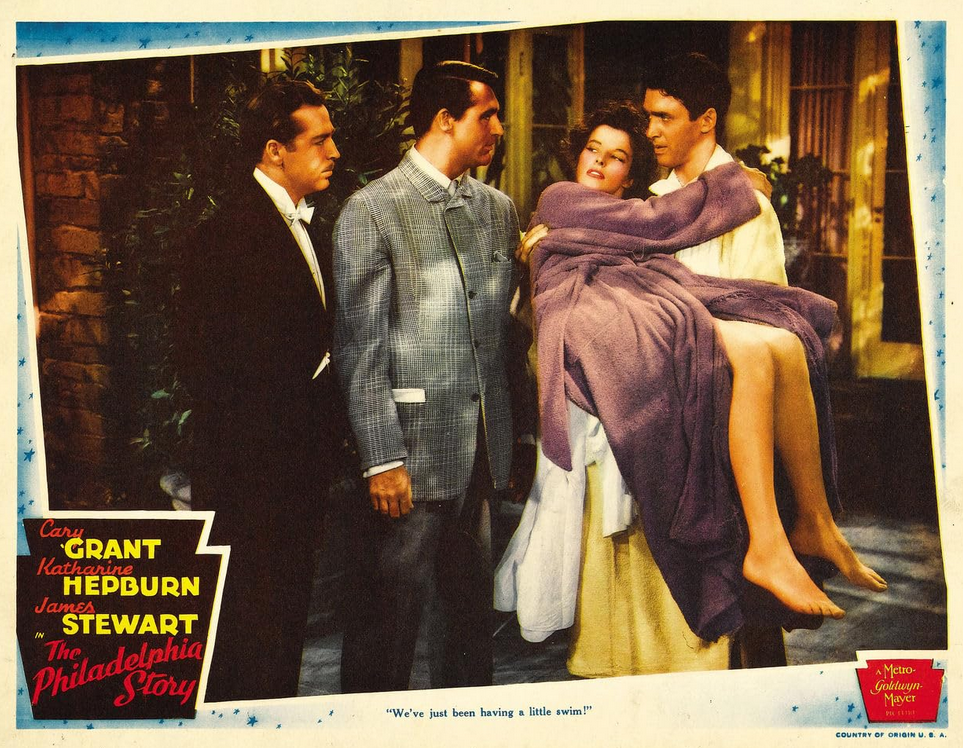
And then, a few scenes later, the newspaper man (who has had too much to drink) admires her as well. The big, glittering, ostentatious pre-wedding gala has taken place, and she has broken one of her hard and fast rules. She’s had a bit too much as well, so all her inhibitions have washed away. But newspaper man Macaulay Connor (Jimmy Stewart) sees her as a real woman.
- Macaulay Connor: Tracy.
- Tracy Lord: What do you want?
- Macaulay Connor: You’re wonderful. There’s a magnificence in you, Tracy.
- Tracy Lord: Now I’m getting self-conscious. It’s funny. I – Mike? Let’s…
- Macaulay Connor: Yeah?
- Tracy Lord: I don’t know – go up, I guess, it’s late.
- Macaulay Connor: A magnificence that comes out of your eyes, in your voice, in the way you stand there, in the way you walk. You’re lit from within, Tracy. You’ve got fires banked down in you, hearth-fires and holocausts.
- Tracy Lord: I don’t seem to you made of bronze?
- Macaulay Connor: No, you’re made out of flesh and blood. That’s the blank, unholy surprise of it. You’re the golden girl, Tracy. Full of life and warmth and delight. What goes on? You’ve got tears in your eyes.Tracy Lord: Shut up, shut up. Oh, Mike. Keep talking, keep talking. Talk, will you?
There it is.
Even the heiress just wants to be a human being.
But here’s the thing. She’s stuck. She wants to think of herself as someone who ignores the social conventions that formed her, but she also believes she can be part of what brings her putz of a fiance into Society. She flouts convention by divorcing her equally wealthy first husband (when he makes a fool of himself by getting publicly drunk), but her dad – he’s a problem for her. He’s thrown some mud on the family reputation by being publicly linked with a dancer. Tracy cares a lot more about that public reputation than she wants to, and she cares a lot about her mother. Her has been cruel to his wife with the scandal. And Tracy is as angry as a hornet about it. She’s angrier than her mother is.
So the father and the daughter have an argument. She gives her father what for. Really reams him out. But it’s a measured argument. Neither one is willing to lose self-control. It’s the kind of argument I would have with my own father in the coming years, but at the time I had never dared. In the heat of the argument on the screen, Tracy dares her dad to go ahead. Tell her what’s wrong with her. (She dares him, I can see now, to be the dad.)
So he does. He checks things off, one at a time, and he’s completely calm about it. It’s a short list. He actually likes his fiery daughter. He starts with the stuff she’s done well. But then he sums it up in a line that came to me in the summertime of my own life, from the old movie screen, there, where I sat in a tattered old seat in the tattered old theater, a teenage girl on the cusp of my own womanhood, next to my own dad, with my mom exuding a gathering storm of disapproval from down the row.
With a cocktail in his hand, Tracy Lord’s dad said – to me, it felt like,
You’ll never be a first-class human being or a first-class woman until you’ve learned to have some regard for human frailty.
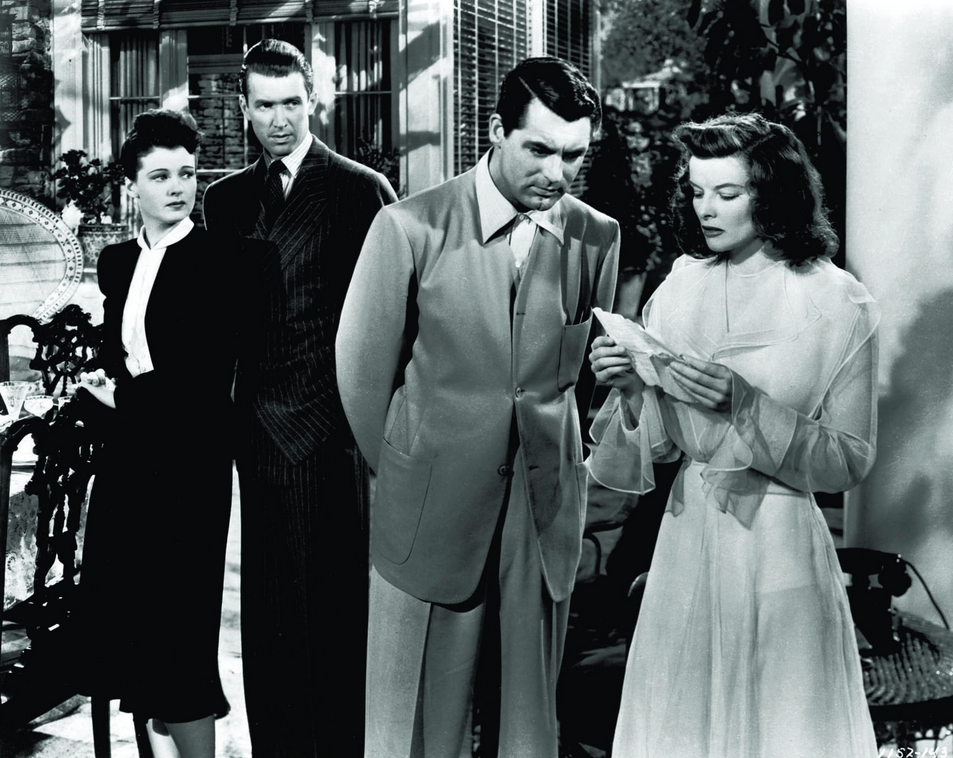
The putz doesn’t see it that way. He finds out about things, draws the worst possible conclusions, demonstrates a starchy and correct morality, and writes Tracy a note to call things off. (Ruth Hussey’s performance as the newspaper photographer is worth watching the whole movie for, by the way. That’s her, on the left, beside Jimmy Stewart.)
I think it was the drunkenness thing that made my mom mad in the car all the way home that day. She was gripping her self-control so tightly it’s a wonder the windows of the car didn’t develop stress fractures. I’m sure there was a private conversation later that night after we kids had gone to bed. Mom’s dad had been a drunk, you see, and not a rich one. Not a man of self-control. My mom thought the movie putz was the good guy. That much, she had made clear in the car on the way home.
It was supposed to be a day out for the family, and it was supposed to be fun, and it was supposed to be a dark old theater in the middle of the day on a bright, sunny Saturday, and maybe ice cream on the way home. It was supposed to be nostalgia and our modern family, together, laughing.
It wasn’t. My poor dad.
In the fifty years since that day (yes, fifty), I have seen a lot of movies. I ended up marrying a man who loved cinema, and loved it in all languages. Cinema was a sort of test I needed to pass before he could really fall in love with me. I had to know how to handle vinyl LPs properly (not a skill passed to me by my hi-fi, LP-stacking father), and I had to love movies. The Philadelphia Story is in our collection, along with all the other great films of that era.
And meanwhile, in my real life, I have seen a lot of human frailty. And too much of the time I have been the putz. I have been intolerant. Too often, I have not had any regard for human frailty at all. I smelled fear in my mother’s reaction that day, and, in imitation of my dad, I decided as I came into womanhood that I would not to be afraid. It has sometimes made me mean.
Lately I’ve been talking to one of my kids – talking about their childhood, and my parenthood. It’s like watching an old movie in a tattered theater in my mind, and I am dismayed. Chagrined. Embarrassed. I thought I had rejected my mother’s fears. I thought I had learned not to be the putz. But while I was spending all my energy attempting to inoculate my kids against generalized putziness, while I was combing their world for tripping hazards (while, I thought, leaving them free to climb), while I was pointing out the world’s intolerances, it turns out I missed a bit. Mine.
In the scene with the father and the daughter, a thing happens that was as opaque to me as it had been to my mom that day. Sometimes the people you least believe to be good are setting you the best example. Having some regard for human frailty does not mean accepting the fact that other people behave badly. It means dropping the conversation once the conversation is over. It mean following the example of the probably philandering dad with the cocktail in his hand, who, having said his piece, was still proud of his daughter. He was unwilling to bend to her will and her judgement, but he was also unwilling to attempt to force her to bend to his. He said what he thought, when asked, but he made no demands on her. She’d been behaving like a lunatic, acting as if she were caught between the putz, the disappointment, and the rescue, but all along she’d been so full of her own ability to command the world to behave itself that she’d missed her own frailty.
I didn’t understand anything that day. I was really young. But the words entered some deep place in my body, took root in my nous, shaped my life. It turns out that having some regard for human frailty doesn’t mean you just decide you’ll permit other people to be stupid. To behave stupidly. To be fools. It means that you can’t arrange the world so that other people will do what you think they should do. It means that you’re frail too, and foolish often. It means that trying to be the mom who arranges a world in which your kids can’t or won’t ever go wrong is, itself, more than a little putzy. It means that it’s better to be a human than to be made of unassailable bronze.
My kid thinks I’ve changed. Recently, he thinks. Since I entered Orthodoxy, he’s said.
I hope that means I’ve started to learn to repent.
And thanks for taking us to the movies that day, dad.

