A little more than 35 years ago, I flew across the country from PDX to Baltimore for a Silent Retreat at the then last traditional Episcopalian convent where the nuns lived in traditional habits and kept all the traditional rules – The All Saints Sisters of the Poor. Few things in my life have carried more emotional and spiritual weight than that retreat carried, and today I am thinking about them again.
A taxi from the airport dropped me off a day before the Retreat was set to start, and the sisters put me up in the guest wing of the Convent building. All the rooms were named for specific things or people, and the room in which it was okay to talk aloud was called The Visitation. (I still smile about this.) I was informed that if I saw someone wearing a blue arm band, that person was in silence even if they were sitting in that room, and I was not to bother them. (Wouldn’t it be lovely if we could all do this? Just put on a blue arm band, and nobody will bother you. Likely, I grow more from learning to be bothered than I would from never being bothered, but still. It seems like a very good idea.)
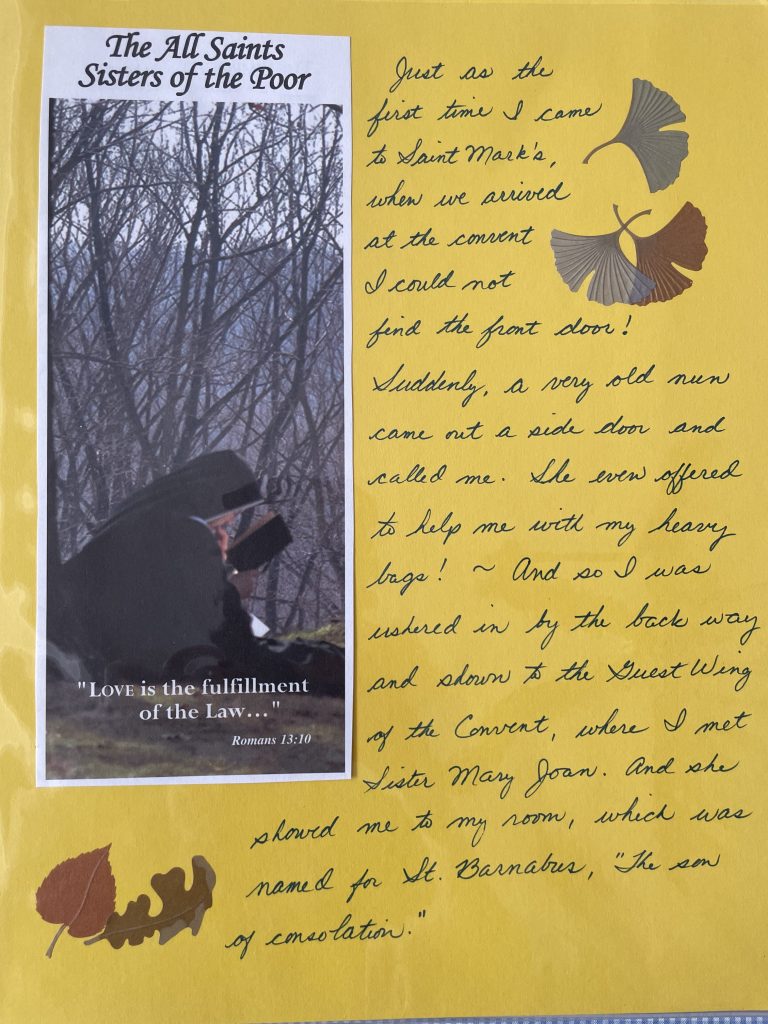
The next day, St Mary Joan, the sister in charge of the Associates, and therefore the sister to whom I had been writing my quarterly letters for a while, showed me to my room in the Retreat House. This was a sprawling, solidly 19th century building with beautifully creaking polished wood floors, and many rooms, along many hallways, across two levels, with a central living room space in the center of the first floor. In the yard, just off to the side, there was a surprisingly small, now somewhat dilapidated old metal swing set. Something of the shouts and running of children seemed kind of lingering in the air.
It turned out that, back in the midcentury, The All Saints Sisters of the Poor had cared for children afflicted with Rheumatic Fever. The entrance porch had a plaque on the wall explaining this. I read it when I set my baggage down for a moment before we went in. I stood in that entryway for the first time, read the plaque, and felt like all the breaths I’d ever exhaled had come suddenly back into my body to fill me.
See, while the sisters in Catonsville had been caring for these children on the east coast, I had been receiving treatment for the same thing in Portland, Oregon. It was the early ’60s for me. I was a preschooler.
So that was the first big thing. That was the first thing that knocked me silly.
Most of the people at the retreat were locals. At the first meeting on the first day of the retreat, they had just arrived from their homes. Their bustling energy felt like a breeze had picked up, but it settled down soon enough. We got our instructions about silence being the rule, talking being the exception (for the sisters, all the time, and for us on Retreat for the next three days) and then we were shown into the little chapel built onto the side of the Retreat House.
I sat in my folding chair facing the plain altar and the wall of windows behind it, looking into the trees of the woods. Sr. Julia Mary clicked the cassette tape recorder on her table, and the first phrases — the refrain — of that Taize piece came into the room. “Stay with me. Remain here with me. Watch, and pray.” I saw a goldfinch in the trees. The room came to rest. And the tape recorder made another mechanical click and turned off.
The Retreat was about becoming a Contemplative.
Over the course of the days, Sr Julia Mary explained to us that at the end of our lives, if we live long enough, we end up as contemplatives whether we ever wanted to be or not.
In the active time of your life, she explained, you’re supposed to be active. It is not wrong to volunteer for everything at church, or serve in your local community in some way, or go to work, or raised children. This is what builds a world in which we all live. The work of Christ in the world needs every sort of vocation to be operating and healthy.
But in the end, it all stops. In the end, your body will not allow you to work in that same way. In the end, she said, you will be able to pray if you have practiced praying and you know how.
She had seen too many older people who could not stand to have the television off. They wanted the company. They wanted something outside of themselves to attach to, to be aware of. Can you stand to be in silence now, she asked? Do you practice being in silence?
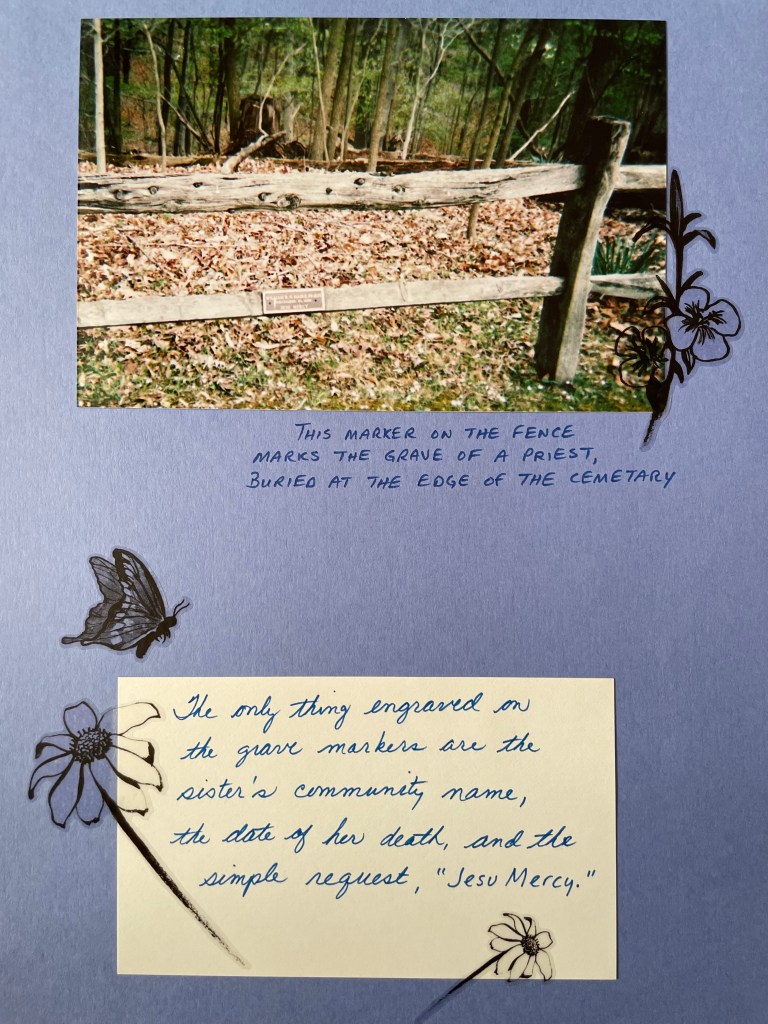
She told the story of an elderly nun who had recently died, there, at the convent, and was now buried in their graveyard. At the end, she had lost nearly every faculty, but she could still speak a bit. Her last words were, “thank you.”
“Habit will sustain you where will cannot,” she said.
She was not wrong. But – with all love and gratitude I have for her and the All Saints Sisters, I think now that they were missing something.
When a person plays a musical instrument, something happens inside the player. The very elderly, people with dementia who have stopped communicating in nearly every other way, have been known to recover themselves at a keyboard or with their mouths on the mouthpiece of a horn, or with a bow in their hand. This is no mere habit. This is no Puritan work ethic being remembered or built structure being found. This is living tissue of humanity. This is a soul. A nous.
I never heard about the nous before I came into Orthodoxy. In short, it’s the ancient Greek way of talking about spiritual perception. Like physical perceptions of smell and sight and taste and touch, the nous perceives God. That’s how we talk about it in the Orthodox tradition, and it’s the aspect of our humanity we work at, just like a violinist works at scales and fingering and all the rest of it to make the instrument and the player into a unity of Music.
I had a student once, at church, who was a gifted violinist. She told me that her teacher had said, “Practice does not make perfect. Practice makes permanent.”
And it doesn’t matter what your instrument is. If you are practicing ~ practicing gratitude or patience or flower gardening or using public transportation or dealing with ordinary aches and pains as you age and change and grow ~ it matters what you do in that practice. And it matters why. It matters how. It matters to what end.
That’s the part I think completes the thought given to us by St Julia Mary: the end.
If you practice your practices for Love, then, at the end, Love will sustain you where willpower and even habit cannot.
When I visit my husband now, at the end of his life, when I go to the Adult Family Home where he will die, and probably soon (although his habit is to remain steadfast, and his mortality has lasted for longer than anyone expected) … when I see his face, sometimes more vacant and dumbly accepting (or mutely panicking) … and then when he sees mine, Love sustains us. Nothing else seems certain, but Love does.

